Photo credit: Pal Hansen
Shapeshifting actor Bill Pullman unpacks his latest role as convicted killer Alex Murdaugh in the Lifetime miniseries “Murdaugh Murders: The Movie.”
Source: Bill Pullman wishes he hadn’t waited so long to work in TV
Photo credit: Pal Hansen
Shapeshifting actor Bill Pullman unpacks his latest role as convicted killer Alex Murdaugh in the Lifetime miniseries “Murdaugh Murders: The Movie.”
Source: Bill Pullman wishes he hadn’t waited so long to work in TV
Bill Pullman, 70, is an actor known for his roles in the films “Independence Day” and “The Ballad of Lefty Brown” and TV’s “The Sinner.” He most recently starred in Lifetime’s “Murdaugh Murders: The Movie.” He spoke with Marc Myers.
Hornell in western New York was a town of about 13,000 people when I grew up there in the 1960s. My friends and I had some good adventures, but I spent more time by myself.
In 10th grade, my math teacher told a story that made everyone laugh. Then she stopped and asked, “Why didn’t you laugh, Bill?” I had no idea. That’s when I realized I wasn’t often in sync with classmates around me.
I didn’t feel like an artist during childhood and had no idea how artists behaved. I just enjoyed time alone where I could sort out the stress at home and get my life in order.

My parents and my six siblings lived in one of the bigger homes in Hornell—a redbrick house built in the 1890s with a mansard roof and cast-iron elements that framed our windows. We had lots of rooms upstairs and in the basement.
We also had a place 11 miles out of town in a more rural area. My parents called it “the farm” though we had no animals or crops. We’d go up there every Sunday, and often each of us could disappear for hours. My father, James, was a physician and always seemed happiest at the farm. My mother, Johanna, a homemaker, viewed it as a refuge.
Our family was large, even for those days. The first born was Jay. Then came Helena, Linda, Joe, John, me and, finally, my younger sister, Johanna.
I grew up in a chaotic household. My father’s addiction began with alcohol and then shifted to painkillers and other self-medicating drugs. He went through a tough period, though he was a generous, dedicated person.
My mother began having psychiatric problems when she was 49. She was diagnosed schizoaffective—a disorder with multiple schizophrenia symptoms such as delusions, depression and mania. She’d had a mental breakdown when I was 7 and was in and out of treatment for many years. Yet she was warm and generous as well.
My father was highly functional, but in his 50s, he had occasional moments of atypical behavior. My mother would become a little manic or have calibrations of voice and tone and other things that became tells.
As a result, I studied behavior early and became attuned to factors that brought on personality shifts. I also had to try to help control the situation at home.
My father had many patients who were farmers, so he encouraged my brothers and me to work summers on farms. Picking up freshly cut bales of hay and tossing them into the wagon was hard work.
In high school, I was a pretty good student. I made the honor society and won a National Merit scholarship. I also was cast in the school’s renditions of “The Devil and Daniel Webster” and Woody Allen’s “Don’t Drink the Water.” But acting wasn’t a passion yet, just a diversion.
I wasn’t sure what I wanted to pursue in college, so I applied to a two-year program for building construction at SUNY Delhi in upstate New York. One day, I tagged along with some refrigeration students auditioning for a campus play, “The Bald Soprano.” Lo and behold, I was cast.
The moment director Bill Campbell asked the cast and me to read the script out loud, I felt an emotional lightning crack. I still didn’t see myself as an actor, but Bill did. He encouraged me to attend SUNY Oneonta’s undergraduate theater program and said I’d likely get a graduate degree in theater and direct plays. “It’s a good life, you’ll like it,” he said.
Somehow that’s exactly what happened. I went to Oneonta and then attended UMass Amherst. In the middle of my second year of grad school, Bill asked me to take a leave to assume his position for a year. So I did.
While in grad school, I spent a couple of summers acting and directing for a theater company that toured Montana. After I finished my MFA, Montana State University asked me to teach and direct for a year. One year turned into two.
There came a point when I wanted to return to acting. The woman I was going with, Tamara, was an undergrad. She came out to Montana to visit and began nudging me to relocate to New York. In 1981 we made the move.
I worked in theater in New York, and while doing a play in L.A., I was cast in the 1986 movie “Ruthless People.” Tamara and I married in 1987.
Today, we live in Beachwood Canyon in L.A. We moved into our house in 1991. We had enough land to create terraces, where I tend 60 varieties of fruit plants and trees.
We also spend time at the Montana ranch we have next to my brother and sister-in-law’s ranch. I love walking the trails nearby and watching for animals and birds. I love the solitude.

Downtime? We love spending time in our L.A. orchard and garden, though I’ve dragged Tamara into a lot of renovation stuff.
Stuff? We’re renovating an old brick building near the San Gabriel Mountains. It will be a live-and-work space for artists. A couple of our kids want to live there, too.
Montana? When possible, we help drive cattle to the upper mountain pastures for the summer.
Views? It reminds me of the Westerns I loved as a kid—“Shane,” “Red River” and “Missouri Breaks.”
Cooking? Tamara cooks quite a bit. I love her Israeli chicken dish with prunes and olives. It’s a flavor explosion.
The actor on his parents’ personality shifts, his love of Montana and what he does in his downtime
By Marc Myers
June 11, 2024 11:08 am ET
https://www.wsj.com/real-estate/bill-pullman-murdaugh-murders-2ec68246

Dan Doperalski for Variety
Bill Pullman opens up about prepping to play Alex Murdaugh and compares his son, Lewis Pullman’s hit show, ‘Lessons in Chemistry’ to ‘While You Were Sleeping.’
Jun 10, 2024 1:03pm PT
Bill Pullman is a liar.
The star of “Murdaugh Murders: The Movie” doesn’t mean to be, but confesses he is one during our interview.
The two-part Lifetime movie in which Pullman portrays convicted murderer Alex Murdaugh wasn’t, by any means, a light-hearted project. And while focusing on heavier topics, some actors turn to “comfort” TV or movies.
One of mine, I tell him, is “While You Were Sleeping,” his 1995 rom-com with Sandra Bullock. But he doesn’t have one. And that might come as a surprise if you’ve watched recent FYC press he’s done. In fact, he was asked about it on a panel three days before our conversation.
“They asked a similar question, and I lied,” he whispers. “I just told my publicist today, I feel so bad! Something about that question, I couldn’t think of anything that was accurate. The only thing I could think of was that it’s comforting to watch actors you know. Bessie Carter, I’ve worked with, and I know she’s in ‘Bridgerton’ and that I want to watch ‘Bridgerton,’ so I said ‘Bridgerton.’”
He continues his whisper, “But I’ve never watched ‘Bridgerton.’ I thought, ‘Why did I do this?’ So, you’re giving me a chance to
be honest.”
Now speaking at normal volume, he admits he doesn’t really have a feel-good show he puts on in the background, mostly because he gets so engrossed in stories that he can’t look away or multi-task.
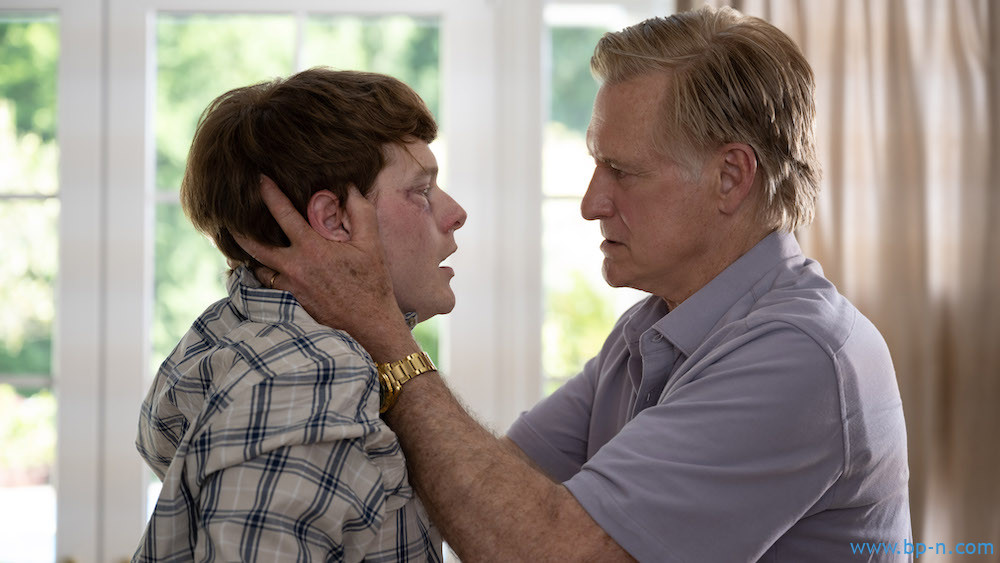
So, while filming “Murdaugh Murders,” Pullman turned to distracting himself with audio instead of visuals. Though he doesn’t enjoy diving into his process, Pullman’s team prepared him for our conversation — and he spent the time to really look back at filming.
“I do use music a lot. I remember I had some great inspiration, but it had left me. There was one song that I had used a lot and, for some reason, I remembered it this morning,” he says. “It’s ‘Defying Gravity,’ but not from ‘Glee.’ It’s written by Jesse Winchester, who was a kind of folk singer-songwriter of ’70s and ’80s. It’s a very sweet lullaby song.”
After reciting the lyrics — “I live on a big blue ball, I never do dream I may fall. But even the day that I do, I’ll jump off and smile back at you” — Pullman explains that those “dreamy” words always reminded him that even if things don’t work out, to remember “it’s not going to be a catastrophe.”
Though it may sound like a unique choice, his other musical interest is even more random: The score from the 1999 John Travolta movie “The General’s Daughter.”
“It was after Moby had started sampling old folk Library of Congress recordings and making them into set tracks and adding layers,” says Pullman, who would listen to them “when I realized I’d be too much in the world” of Murdaugh.
But throughout his career, it hasn’t always been easy for Pullman to get in and out of a character. Even when he feels like he’s moved on, he later realizes that’s not the case. That was what happened while filming 1997’s noir thriller “Lost Highway.”
“Sometimes you have little tells. I remember coming home after a ‘Lost Highway’ day. I had young kids at the time. My wife was asking me something, I was getting into the refrigerator, and I guess a thing welled in me,” he remembers. “I had a whole quart of milk, and I just slammed it down on the floor. I don’t normally do that kind of thing. I realized it was something that resurged.”
Usually, Pullman is quite a family man. In fact, his son Lewis Pullman is also in the Emmys conversation thanks to his role in Apple TV+’s “Lessons in Chemistry.” Lewis’ series debuted on Oct. 13, while the Lifetime films aired on Oct. 14 and Oct. 15. So they made it a three-night family event.
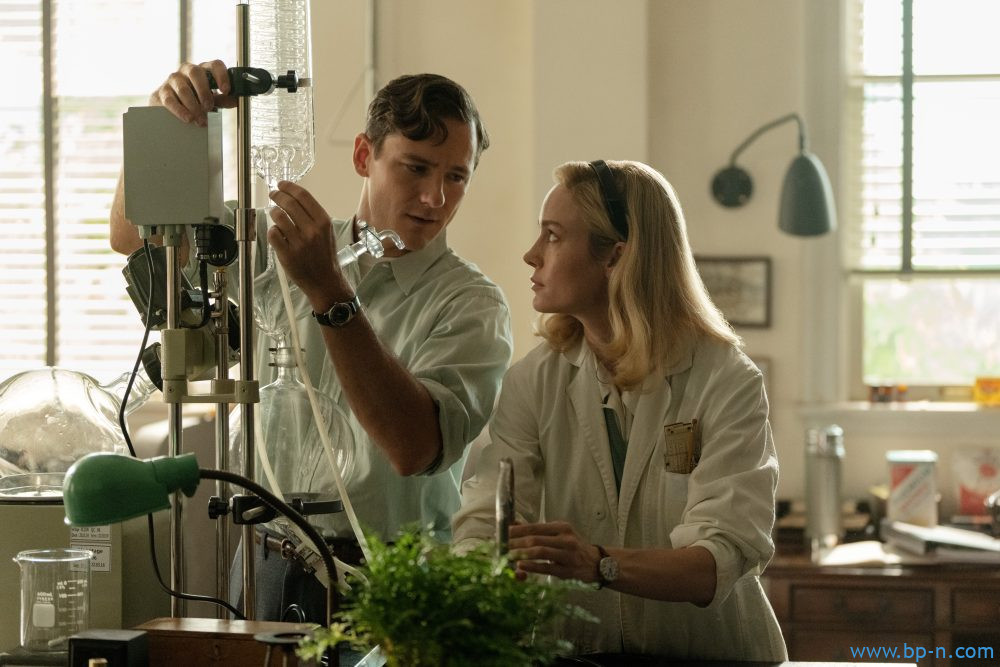
“We said, ‘that’s so weird that we’d have night, night, night of Pullman men.’ We’re not a sports family; we don’t watch the Super Bowl together. Let’s say we’re like a sports family but we’re watching the sport of acting,” the veteran thesp says. “So he came over and watched. It was really fun and then we debriefed. Our little plan has always been debriefing. It’s not finished until you can get around the table.”
Watching his son work and grow in this industry has been a huge gift for Pullman, who says Lewis is such a hard worker that he may prep better than his father does.
“It’s just the mechanics. It’s not a competitive thing, but there is awareness that he involves himself in. If you go into his apartment on location, he’s got all this stuff happening to prep. I used to do a version of that,” he says, explaining that he’d cover paintings in hotel rooms with brown construction paper. “Then I’d fill it sometimes with things that were connected somewhat. But it was nowhere near the level that Lewis goes to. I think his brain needs to [see it]. He’s so good at that.”
Pullman says that “Lessons in Chemistry” was “lightning in a bottle” for his son — something he relates to his experience on “While You Were Sleeping.”
Recently, producer Jonathan Glickman said on a podcast that Pullman wanted to quit the movie after the table read but couldn’t because he’d just quit something else. Glickman also claimed that Pullman and co-star Peter Gallagher asked about reversing their roles to better the story; that never happened, but once director Jon Turteltaub joined the production, the story was improved.
“Oh, my God. I gotta watch my mouth,” says a shocked Pullman through laughter as I tell him the quotes. “I think I had pulled out of a movie — which is the only one I ever did! I didn’t know Jon by the time we were at the table read but he was secret sauce, and he gave Sandra and I permission to really be free. He did so much to it, and he would never take credit for it.”
Looking back, Pullman remembers Turteltaub telling him and Bullock to trust him, even when it wasn’t on the page. And it worked.
In one scene, Pullman’s Jack explains to Bullock’s Lucy that when a man is interested in a woman, he “leans,” which is very different than “hugging.” A fan-favorite moment — “people call it the leaning scene,” he says — wasn’t on the page.
“The whole lead into it was great, and all improvised at night,” says Pullman. “I think it was Jon’s idea.”

From BroadwayWorld’s Archive: THE LAST SHIP – the new musical with music and lyrics by 16-time Grammy Award-winner Sting and book by Tony Award winner John Logan and Pulitzer Prize-winner Brian Yorkey opened last night, October 26. The Last Ship is directed by Tony Award winner Joe Mantello and choreographed by Olivier Award winner and Tony Award nominee Steven Hoggett. BroadwayWorld’s Richard Ridge was on the red carpet to chat with the big guests of the night before the curtain went up. Click below to check out interviews with Sarah Paulson, Bill Pullman, Lin-Manuel Miranda, and Sting himself!

The Pullman Family’s Emmy Quest
Bill Pullman joined Morning Joe to discuss his role as Alex Murdaugh in the Lifetime movie “The Murdaugh Murders.” The two-part series follows the downfall of the Murdaugh family, centering on Alex Murdaugh’s crimes and trial.
Source: Bill Pullman on becoming Alex Murdaugh: ‘Satan looked at him and went whoa, dude. You’re bad’

Bill Pullman discussed his role as Alex Murdaugh in Lifetime’s ‘Murdaugh Murders: The Movie’ at an American Cinematheque Q&A.
Source: Bill Pullman Had 10 Days to Prep, 30 Days to Film ‘Murdaugh Murders’
The star of Lifetime’s “Murdaugh Murders: The Movie” told an American Cinematheque audience how and why he took on the role of a notorious killer in a departure from his nice guy image.
Bill Pullman has long been one of the most versatile actors in America, not only given the breadth and depth of his performances but also the variety of forms in which he skillfully operates; he’s delivered iconic work in noir (“Lost Highway“), sci-fi spectacle (“Independence Day“), romantic comedy (“Sleepless in Seattle”), Westerns (“Wyatt Earp”), and horror (“The Serpent and the Rainbow”), among many other genres. With last year’s Lifetime film “Murdaugh Murders: The Movie,” Pullman added true crime to his résumé, and the result was not only one of the best movies ever to air on that network (“Murdaugh Murders” was the 500th Lifetime Original Movie) but one of Pullman’s most surprising performances — surprising both in the depth he found in a murderer most of us know as a tabloid journalism caricature, and in the way Pullman suppressed and obliterated his own natural nice guy charm to disappear into the character.
Although Pullman has shown his dark side before in movies like “Lost Highway” and “Surveillance,” “Murdaugh Murders” represented an additional degree of difficulty in that the actor had to emulate a figure well known to millions of people — though not, ironically, to Pullman himself. When his agents sent him the script, he had no idea who Alex Murdaugh, the South Carolina attorney found guilty of murdering his wife and son, was and wasn’t particularly interested in playing him. “Then I read the script, and there was something in the dialogue,” Pullman told an audience at a recent American Cinematheque event honoring his work. “It turns out that a lot of it came from transcriptions.” Pullman credited screenwriter Michael Vickerman with skillfully incorporating real-life dialogue from Murdaugh’s case and recreating its rhythms in scenes that were fictionalized. “The scenes all kept that tenor, that crazy syntax, and I started to take a look at that and thought this would be a good journey. We had to do it fast, but it would be worthwhile.”
When Pullman says that the filmmakers had to work fast, he’s not kidding. Due to an impending SAG strike, Pullman had less than 10 days to prep for the role, and the movie itself had a shooting schedule of around 30 days — a race against the clock for a three-hour film of its scale and ambition. Pullman gave himself a crash course in all things Alex Murdaugh by diving into archival footage and studying the killer’s dialect and body language. While Pullman’s external transformation is complete and stunning — it comes as a real shock to the system for anyone who remembers Pullman from his affable “While You Were Sleeping” and “The Accidental Tourist” roles — what really interested the actor was the character’s internal contradictions. “I had a conversation with [director] Greg Beeman before we started, and asked him, ‘Did Alex love his wife and son?’ He said, ‘Absolutely,’ and I thought, that’s the paradox. That’s what we’re investigating.”
For Pullman, the trick was to play Alex’s contradictions without revealing more than the real Murdaugh did since, as Pullman notes, he had everyone around him fooled. “The people that were around him for all these years never saw anything that was there underneath the surface,” Pullman said. “And these were not dumb people. They just believed he was their lifelong friend and a fun guy to hang out with.” Over the course of the movie, Murdaugh’s appearance changes considerably, something Pullman had to suggest in the way he carried himself, given that the tight schedule meant he didn’t have time to gain or lose a considerable amount of weight. Working in close collaboration with the wardrobe designer as well as his hair and make-up artists, Pullman managed to give the impression that his body had completely transformed even though the effect is often just a sleight-of-hand of movement and costuming.
Although Pullman acknowledges that he would have liked more time to delve further into his character, he ultimately feels that the modest budget and fast speed of the “Murdaugh Murders” shoot created its own kind of enthusiasm among the cast and crew. “The director was really collaborative, and it was a very young crew that gave 110 percent,” Pullman said. “I think some of that was them asking, ‘Can we really pull this off?’ That created this little incubator where we were going really fast but feeling confident that we were getting something.” In the end, Pullman is grateful not only that the movie came out as well as it did but that people are discovering it amidst the vast sea of content currently available on television and streaming platforms. “I’m very thankful to have this movie looked at, because there’s definitely a lot of production out there. But you know, sometimes you get a certain kind of pitch, and you can hear the bat hit it, and it cracks. And I felt like this was a movie like that.”
“[‘Magic’] cracked the sky open for me about what it is to be concealing something underneath, that you’re feeling… And how long it can take before [there’s] an eruption and you can’t keep it concealed anymore.”
Photo by Xavier Collin/Image Press Agency/NurPhoto
Actor Bill Pullman reveals how Anthony Hopkins’ performance in ‘Magic’ opened him up to a world of nuance.
Source: Actor Bill Pullman on concealing secrets in a performance
Critic’s choice and SAG-nominated actor Bill Pullman has starred in raucous laugh fests like Spaceballs, and crowd pleasing romantic comedies including Sleepless in Seattle and While You Were Sleeping. Recently, he’s received acclaim for his roles in darker projects: USA network anthology series The Sinner and the Lifetime miniseries Murdaugh Murders, based on the story of convicted killer Alex Murdaugh.
More: Pullman Two-Hander (Theatre Talk, 2009)
For his Treat, Pullman shares that whenever he wants to see a subtle performance from a character trying to keep things under control, he returns to the 1978 psychological horror film, Magic. The film is directed by Richard Attenborough and stars Oscar winning actor Anthony Hopkins, Ann-Margret, and Burgess Meredith.
This segment has been edited and condensed for clarity.
I’m gonna tell you about a piece of film that is something I continually go back to for a lot of different levels. [I think a lot] about a particular scene in this movie called Magic, which [stars] Anthony Hopkins. [It’s based on a] William Goldman novel — Richard Attenborough directed it — and Burgess Meredith plays the agent to a ventriloquist, who’s played by Anthony Hopkins.
Anthony Hopkins has been somewhat challenged by his dummy, who is capable of saying things that he himself really doesn’t feel responsible for and so Hopkins, his character, is shaken by it.
So he goes to the Catskills and he’s in a cabin that’s on a lake and it’s very quiet, peaceful. And then Burgess says, “Is it alright if I come up and see you?” And then he comes up and says, “How’s it going?” Hopkins is so friggin’ brilliant [here].
That was a real awakening to me about how subtle film could be. [I was] doing a lot of theater, and just watching the nuances of his version of “I’m under control. I got things handled. It’ll never happen again.” [Really?] And Burgess Meredith is perfect casting [for his role] … and there are these close-ups on Anthony Hopkins’s forehead [with] the strips of sweat.
I always went to movies growing up. Matinees, John Wayne, WWII stories, and everything. [When I went to] college, I started to see other kinds of movies. [‘Magic’] cracked the sky open for me about what it is to be concealing something underneath, that you’re feeling… And how long it can take before [there’s] an eruption and you can’t keep it concealed anymore.

He’s played good guys and he’s played bad guys. David Lynch sees something in his eyes that could be trouble.
Source: Bill Pullman gets into the twisted mind of a killer. He could use a few laughs now
Why in the world was a nice guy like Bill Pullman asked to play a monstrous killer — convicted of murdering his wife and son — in Lifetime’s ripped-from-the-headlines, two-part miniseries “Murdaugh Murders: The Movie”?
“I kept thinking maybe it’s because they anticipated I’d look all right with ginger hair,” jokes the warm and genial Pullman during an early spring interview in Los Angeles.
But a switch in hair color was just a small part of the actor’s deft transformation to evoke Alex Murdaugh, the South Carolina lawyer — and scion of a prominent legal family — who’s currently serving two consecutive life sentences in state prison for the 2021 double homicide. (He was also sentenced to 40 years for financial fraud.)

Not that Pullman’s dye job didn’t initially worry the veteran actor. “The movie’s makeup and hair heads took me to a [suburban Vancouver] strip mall where there was this beauty salon and I just thought, ‘Oh, my God, how did this happen?’” he says with a wry smile. “But they did an excellent job.”
Though he’s perhaps best known for warm-hearted or heroic roles in such movies as “Sleepless in Seattle,” “While You Were Sleeping” and “Independence Day,” a check of his 100 or so screen credits reminds that his career has been peppered with much darker parts. These include serial killers in both the BBC One/Starz series “Torchwood: Miracle Day” and Jennifer Lynch’s 2008 film “Surveillance,” as well as a detective with a troubling underside in USA Network’s anthology series “The Sinner.”
“It was the same when I did ‘Lost Highway,’” recalls Pullman of 1997’s surreal thriller, in which he played a murder suspect. “When they asked [director/co-writer] David Lynch, ‘Why did you cast Bill?’ he said, ‘His eyes. He looks like a guy who could get himself in a lot of trouble.’” (Pullman slyly admits that he’s had a few “harrowing moments” in real life.)
Still, Pullman initially had misgivings about playing Murdaugh in the breakneck production racing against the looming actors’ strike last year. “I think I had probably eight days to prepare,” says Pullman, “and the first two were taken up with me saying, ‘I don’t want to do this,’ because I just had not followed [the Murdaugh story], I had no information. All I knew is that he killed his wife and son.”
But that changed once he finally read Michael Vickerman’s teleplay, which blends transcriptions of actual courtroom testimony, dashcam footage and Murdaugh’s 911 call. “I was intrigued by the text of the script,” Pullman says. “I could feel there was something really unusual going on in the thought process when you actually write things down the way they’ve been spoken. A lot gets revealed in that.”
Discussing the character with the film’s director, Greg Beeman, helped too. “I said, ‘I have the feeling that the bedrock of all this is that Alex loved his wife and loved his son.’ Greg said that was his feeling too. So I thought, ‘OK, that’s a premise we can start from, that’s going to be valuable. It’s a paradox.’”
The actor calls having all those Murdaugh tapes to study “a blessing and a curse” and found that he had to pull himself out of “the weeds” to start inhabiting the role. That’s when, right before shooting began, another key insight struck: He had yet to put himself into the role.

“You realize, everyone’s been looking at this [coverage of the Murdaugh case] and they’re going to want a mirror,” Pullman says. “I told Greg that, just to give myself some slack and some elbow room, I wasn’t going to do an impersonation — meaning I wasn’t going to stand around and say, ‘Oh, [Murdaugh] didn’t turn left when he said that, he turned right.’ And Greg agreed.”
Though the actor was inspired by the abundant footage of Murdaugh, he also didn’t try to duplicate the disgraced attorney’s Southern inflection. “I don’t think of him as having that specific accent,” Pullman explains. “Nowadays there are more urbane people living in the Piedmont. Nobody’s coming out of the hills doing any of those big, back-throated things.” He adds, “But how amazing it was to have that much material to base something on. I just had never had anything like that before.”
And how did Pullman channel the heinousness of his character, who was a habitual liar, drug abuser, embezzler and, ultimately, killer? “Well, I think he’s a guy who says, ‘I can handle everything,’ so that’s the perfect candidate to build up a big thundercloud when he doesn’t know it’s going to rain — and it rains,” the actor says. “Like suicide, it has some psychiatric patterns. You read a bit about brain chemistry and you realize on those arcs of mania and depression, which Murdoch was chasing while using [oxycodone] pills to keep up above the darkness … that people can present as competent — until they’re not.”
Pullman concludes, “That’s all interesting stuff. You don’t get to do that playing a good guy. But it does make you want to do a comedy next.”
