From BroadwayWorld’s Archive: THE LAST SHIP – the new musical with music and lyrics by 16-time Grammy Award-winner Sting and book by Tony Award winner John Logan and Pulitzer Prize-winner Brian Yorkey opened last night, October 26. The Last Ship is directed by Tony Award winner Joe Mantello and choreographed by Olivier Award winner and Tony Award nominee Steven Hoggett. BroadwayWorld’s Richard Ridge was on the red carpet to chat with the big guests of the night before the curtain went up. Click below to check out interviews with Sarah Paulson, Bill Pullman, Lin-Manuel Miranda, and Sting himself!
Bill Pullman joined Morning Joe to discuss his role as Alex Murdaugh in the Lifetime movie “The Murdaugh Murders.” The two-part series follows the downfall of the Murdaugh family, centering on Alex Murdaugh’s crimes and trial.
The star of Lifetime’s “Murdaugh Murders: The Movie” told an American Cinematheque audience how and why he took on the role of a notorious killer in a departure from his nice guy image.
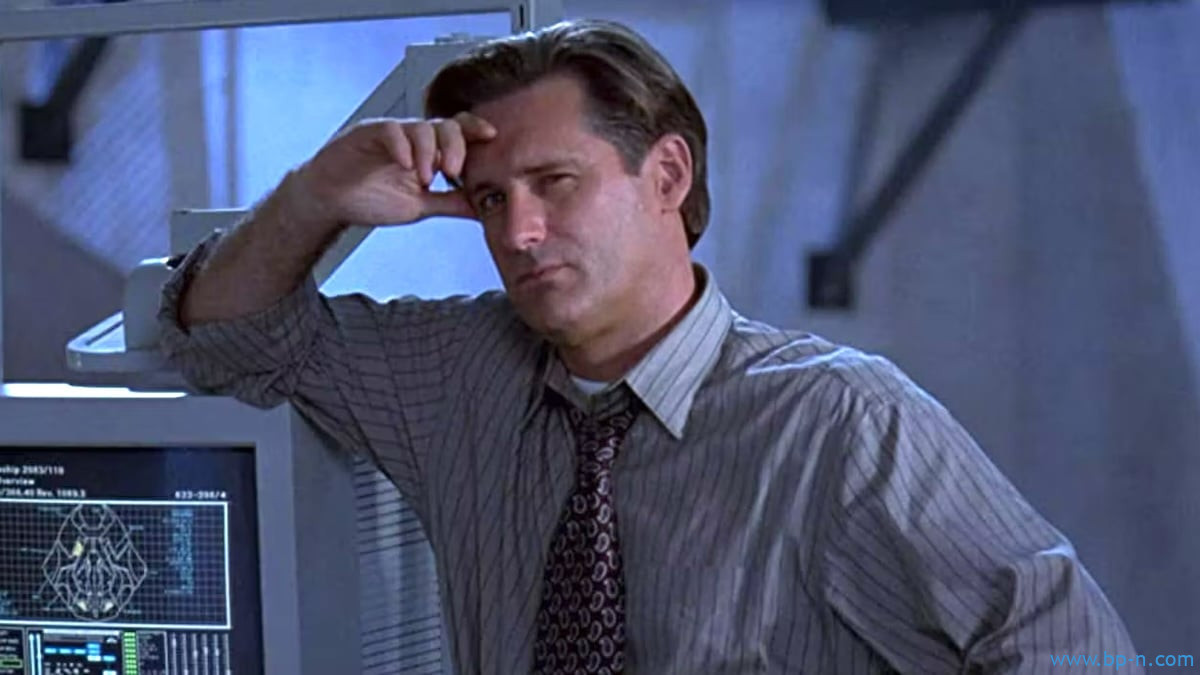
Bill Pullman has long been one of the most versatile actors in America, not only given the breadth and depth of his performances but also the variety of forms in which he skillfully operates; he’s delivered iconic work in noir (“Lost Highway“), sci-fi spectacle (“Independence Day“), romantic comedy (“Sleepless in Seattle”), Westerns (“Wyatt Earp”), and horror (“The Serpent and the Rainbow”), among many other genres. With last year’s Lifetime film “Murdaugh Murders: The Movie,” Pullman added true crime to his résumé, and the result was not only one of the best movies ever to air on that network (“Murdaugh Murders” was the 500th Lifetime Original Movie) but one of Pullman’s most surprising performances — surprising both in the depth he found in a murderer most of us know as a tabloid journalism caricature, and in the way Pullman suppressed and obliterated his own natural nice guy charm to disappear into the character.
Although Pullman has shown his dark side before in movies like “Lost Highway” and “Surveillance,” “Murdaugh Murders” represented an additional degree of difficulty in that the actor had to emulate a figure well known to millions of people — though not, ironically, to Pullman himself. When his agents sent him the script, he had no idea who Alex Murdaugh, the South Carolina attorney found guilty of murdering his wife and son, was and wasn’t particularly interested in playing him. “Then I read the script, and there was something in the dialogue,” Pullman told an audience at a recent American Cinematheque event honoring his work. “It turns out that a lot of it came from transcriptions.” Pullman credited screenwriter Michael Vickerman with skillfully incorporating real-life dialogue from Murdaugh’s case and recreating its rhythms in scenes that were fictionalized. “The scenes all kept that tenor, that crazy syntax, and I started to take a look at that and thought this would be a good journey. We had to do it fast, but it would be worthwhile.”
When Pullman says that the filmmakers had to work fast, he’s not kidding. Due to an impending SAG strike, Pullman had less than 10 days to prep for the role, and the movie itself had a shooting schedule of around 30 days — a race against the clock for a three-hour film of its scale and ambition. Pullman gave himself a crash course in all things Alex Murdaugh by diving into archival footage and studying the killer’s dialect and body language. While Pullman’s external transformation is complete and stunning — it comes as a real shock to the system for anyone who remembers Pullman from his affable “While You Were Sleeping” and “The Accidental Tourist” roles — what really interested the actor was the character’s internal contradictions. “I had a conversation with [director] Greg Beeman before we started, and asked him, ‘Did Alex love his wife and son?’ He said, ‘Absolutely,’ and I thought, that’s the paradox. That’s what we’re investigating.”
For Pullman, the trick was to play Alex’s contradictions without revealing more than the real Murdaugh did since, as Pullman notes, he had everyone around him fooled. “The people that were around him for all these years never saw anything that was there underneath the surface,” Pullman said. “And these were not dumb people. They just believed he was their lifelong friend and a fun guy to hang out with.” Over the course of the movie, Murdaugh’s appearance changes considerably, something Pullman had to suggest in the way he carried himself, given that the tight schedule meant he didn’t have time to gain or lose a considerable amount of weight. Working in close collaboration with the wardrobe designer as well as his hair and make-up artists, Pullman managed to give the impression that his body had completely transformed even though the effect is often just a sleight-of-hand of movement and costuming.
Although Pullman acknowledges that he would have liked more time to delve further into his character, he ultimately feels that the modest budget and fast speed of the “Murdaugh Murders” shoot created its own kind of enthusiasm among the cast and crew. “The director was really collaborative, and it was a very young crew that gave 110 percent,” Pullman said. “I think some of that was them asking, ‘Can we really pull this off?’ That created this little incubator where we were going really fast but feeling confident that we were getting something.” In the end, Pullman is grateful not only that the movie came out as well as it did but that people are discovering it amidst the vast sea of content currently available on television and streaming platforms. “I’m very thankful to have this movie looked at, because there’s definitely a lot of production out there. But you know, sometimes you get a certain kind of pitch, and you can hear the bat hit it, and it cracks. And I felt like this was a movie like that.”
“[‘Magic’] cracked the sky open for me about what it is to be concealing something underneath, that you’re feeling… And how long it can take before [there’s] an eruption and you can’t keep it concealed anymore.”
Photo by Xavier Collin/Image Press Agency/NurPhoto
Actor Bill Pullman reveals how Anthony Hopkins’ performance in ‘Magic’ opened him up to a world of nuance.
Critic’s choice and SAG-nominated actor Bill Pullman has starred in raucous laugh fests like Spaceballs, and crowd pleasing romantic comedies including Sleepless in Seattle and While You Were Sleeping. Recently, he’s received acclaim for his roles in darker projects: USA network anthology series The Sinner and the Lifetime miniseries Murdaugh Murders, based on the story of convicted killer Alex Murdaugh.
For his Treat, Pullman shares that whenever he wants to see a subtle performance from a character trying to keep things under control, he returns to the 1978 psychological horror film, Magic. The film is directed by Richard Attenborough and stars Oscar winning actor Anthony Hopkins, Ann-Margret, and Burgess Meredith.
This segment has been edited and condensed for clarity.
I’m gonna tell you about a piece of film that is something I continually go back to for a lot of different levels. [I think a lot] about a particular scene in this movie called Magic, which [stars] Anthony Hopkins. [It’s based on a] William Goldman novel — Richard Attenborough directed it — and Burgess Meredith plays the agent to a ventriloquist, who’s played by Anthony Hopkins.
Anthony Hopkins has been somewhat challenged by his dummy, who is capable of saying things that he himself really doesn’t feel responsible for and so Hopkins, his character, is shaken by it.
So he goes to the Catskills and he’s in a cabin that’s on a lake and it’s very quiet, peaceful. And then Burgess says, “Is it alright if I come up and see you?” And then he comes up and says, “How’s it going?” Hopkins is so friggin’ brilliant [here].
That was a real awakening to me about how subtle film could be. [I was] doing a lot of theater, and just watching the nuances of his version of “I’m under control. I got things handled. It’ll never happen again.” [Really?] And Burgess Meredith is perfect casting [for his role] … and there are these close-ups on Anthony Hopkins’s forehead [with] the strips of sweat.
I always went to movies growing up. Matinees, John Wayne, WWII stories, and everything. [When I went to] college, I started to see other kinds of movies. [‘Magic’] cracked the sky open for me about what it is to be concealing something underneath, that you’re feeling… And how long it can take before [there’s] an eruption and you can’t keep it concealed anymore.
“When you actually write things down the way they’ve been spoken, a lot gets revealed in that,” Bill Pullman says of getting into his Alex Murdaugh role.
(Shayan Asgharnia / For The Times)
He’s played good guys and he’s played bad guys. David Lynch sees something in his eyes that could be trouble.
Why in the world was a nice guy like Bill Pullman asked to play a monstrous killer — convicted of murdering his wife and son — in Lifetime’s ripped-from-the-headlines, two-part miniseries “Murdaugh Murders: The Movie”?
“I kept thinking maybe it’s because they anticipated I’d look all right with ginger hair,” jokes the warm and genial Pullman during an early spring interview in Los Angeles.
But a switch in hair color was just a small part of the actor’s deft transformation to evoke Alex Murdaugh, the South Carolina lawyer — and scion of a prominent legal family — who’s currently serving two consecutive life sentences in state prison for the 2021 double homicide. (He was also sentenced to 40 years for financial fraud.)
Curtis Tweedie, as the son killed by Alex Murdaugh, played by Bill Pullman, in “Murdaugh Murders: The Movie.”
(Lifetime)
Not that Pullman’s dye job didn’t initially worry the veteran actor. “The movie’s makeup and hair heads took me to a [suburban Vancouver] strip mall where there was this beauty salon and I just thought, ‘Oh, my God, how did this happen?’” he says with a wry smile. “But they did an excellent job.”
Though he’s perhaps best known for warm-hearted or heroic roles in such movies as “Sleepless in Seattle,” “While You Were Sleeping” and “Independence Day,” a check of his 100 or so screen credits reminds that his career has been peppered with much darker parts. These include serial killers in both the BBC One/Starz series “Torchwood: Miracle Day” and Jennifer Lynch’s 2008 film “Surveillance,” as well as a detective with a troubling underside in USA Network’s anthology series “The Sinner.”
“It was the same when I did ‘Lost Highway,’” recalls Pullman of 1997’s surreal thriller, in which he played a murder suspect. “When they asked [director/co-writer] David Lynch, ‘Why did you cast Bill?’ he said, ‘His eyes. He looks like a guy who could get himself in a lot of trouble.’” (Pullman slyly admits that he’s had a few “harrowing moments” in real life.)
Still, Pullman initially had misgivings about playing Murdaugh in the breakneck production racing against the looming actors’ strike last year. “I think I had probably eight days to prepare,” says Pullman, “and the first two were taken up with me saying, ‘I don’t want to do this,’ because I just had not followed [the Murdaugh story], I had no information. All I knew is that he killed his wife and son.”
But that changed once he finally read Michael Vickerman’s teleplay, which blends transcriptions of actual courtroom testimony, dashcam footage and Murdaugh’s 911 call. “I was intrigued by the text of the script,” Pullman says. “I could feel there was something really unusual going on in the thought process when you actually write things down the way they’ve been spoken. A lot gets revealed in that.”
Discussing the character with the film’s director, Greg Beeman, helped too. “I said, ‘I have the feeling that the bedrock of all this is that Alex loved his wife and loved his son.’ Greg said that was his feeling too. So I thought, ‘OK, that’s a premise we can start from, that’s going to be valuable. It’s a paradox.’”
The actor calls having all those Murdaugh tapes to study “a blessing and a curse” and found that he had to pull himself out of “the weeds” to start inhabiting the role. That’s when, right before shooting began, another key insight struck: He had yet to put himself into the role.
Bill Pullman has played troubled men in more roles than you might expect.
(Shayan Asgharnia / For The Times)
“You realize, everyone’s been looking at this [coverage of the Murdaugh case] and they’re going to want a mirror,” Pullman says. “I told Greg that, just to give myself some slack and some elbow room, I wasn’t going to do an impersonation — meaning I wasn’t going to stand around and say, ‘Oh, [Murdaugh] didn’t turn left when he said that, he turned right.’ And Greg agreed.”
Though the actor was inspired by the abundant footage of Murdaugh, he also didn’t try to duplicate the disgraced attorney’s Southern inflection. “I don’t think of him as having that specific accent,” Pullman explains. “Nowadays there are more urbane people living in the Piedmont. Nobody’s coming out of the hills doing any of those big, back-throated things.” He adds, “But how amazing it was to have that much material to base something on. I just had never had anything like that before.”
And how did Pullman channel the heinousness of his character, who was a habitual liar, drug abuser, embezzler and, ultimately, killer? “Well, I think he’s a guy who says, ‘I can handle everything,’ so that’s the perfect candidate to build up a big thundercloud when he doesn’t know it’s going to rain — and it rains,” the actor says. “Like suicide, it has some psychiatric patterns. You read a bit about brain chemistry and you realize on those arcs of mania and depression, which Murdoch was chasing while using [oxycodone] pills to keep up above the darkness … that people can present as competent — until they’re not.”
Pullman concludes, “That’s all interesting stuff. You don’t get to do that playing a good guy. But it does make you want to do a comedy next.”
There are some great Bill Pullman movies, many of which are still enjoyed by audiences today. But none are quite like the 1995 supernatural family classic, Casper. The film follows the eponymous friendly ghost, who haunts a mansion in Maine and befriends the young teen (Christina Ricci) that moves there. In the film, Pullman played the young lady’s dad, who is doubtful of the ghostly presence in their abode until he encounters it himself. The movie was experimental at the time, as it utilized early technology we now know as CGI to create the ghosts. And, due to the tech being new and underdeveloped, Steven Spielberg gave Pullman a warning about watching his movements on the film.
A specific scene in Casper sees Bill Pullman on a staircase, sword fighting with the ghosts. The scene was quite tricky to film, as the While You Were Sleeping actor was expected to execute fight choreography without a battle partner present. The plan was to put the ghosts into the film in post production. This is common practice now and is frequently used in films that require a less-than-human character. However, at the time, it was very difficult and incredibly expensive to pull off. Steven Spielberg, who was an executive producer on the film, warned Pullman about costing the movie excess money. Pullman told Variety:
Really, the sword fight with the ghosts, the three uncles, is up a huge staircase. I just had a toilet plunger that I was battling them with, but it was in the early days of CGI. In those days I would have to do this elaborate choreography with nothing there, but taking those stop points off of aspects of the room. And if I didn’t do it right, if I moved it through something where a ghost was supposed to be it was $100,000. This is what Spielberg said, ‘Be very careful Bill, because you could bankrupt us.’
That’s a lot of pressure, especially for an actor who hadn’t performed opposite CGI before. With the advanced technology used for movies now, there’s a lot more room for error. A lot can be corrected in post production, so a star can more so focus on their performance. However, the classic ’90s flick was somewhat of a testing ground, with the cast having to essentially adapt on the fly. Despite Casper’s occasionally nonsensical plot, the movie was a box office hit, grossing over $250 million. So, ultimately, one would think that Steven Spielberg and co.’s risky investment paid off.
Having the Jaws director on as an EP was surely invaluable for the Brad Silberling-helmed production. The auteur was a pioneer of visual effects, helping to facilitate one of its first ever large-scale uses in Jurassic Park. The dinosaur epic was a turning point for filmmaking of this kind, and it naturally led to directors wanting to experiment with it themselves. The staircase scene alone used more CGI than the entirety of JP. Steven Spielberg’s knowledge was crucial on a logistical level, as well as financial, as he was abundantly aware of how costly it could be. Hence, the warning to Bill Pullman.
All in all, the team was able to make it work and the Sleepless in Seattle star’s movements are spot on. The scene still holds up today, and you can’t even tell the Spaceballs actor was worried about his footwork and the production cost. In the modern days of Avatar and Marvel movies, it’s hard to imagine a world in a producer would have to worry about the placement of a sword so much as to send a warning to an actor. I’d love to hear Bill Pullman compare Casper to the CGI-heavy Independence Day: Resurgence, in which he also starred. Chances are there probably wasn’t a $100,000 production budget concern.
You can revisit Bill Pullman’s performance in Casper, which is currently available to rent on Amazon.
It’s no secret that Bill Pullman is one proud dad! The 70-year-old veteran actor is thrilled that his son, Lewis Pullman, is having such a major breakout year, thanks to his success with the hit Apple TV+ series, Lessons in Chemistry.
Lewis plays chemist Calvin Evans opposite Brie Larson’s Elizabeth Zott in the TV series adapted from Bonnie Garmus’ bestselling novel.
ET’s Dedire Behar caught up with Bill at the Lifetime For Your Consideration event on Wednesday in Los Angeles, where the Murdaugh Murders: The Movie star gushed about his youngest son.
“Let’s talk about Lewis. I love that!” Bill told ET, lighting up at the mention. “I don’t know if it’ll ever happen again, but we’re both doing this Emmy thing at the same time.”
Bill had a proud dad moment when the Pullmans took over Los Angeles billboards, sharing, “Lessons in Chemistry, that came out in October the same weekend that [Murdaugh Murders] came out. Billboards in L.A., you’d go down it’d be Lewis, me, Lewis, me. All the Pullmans!”
Bill also praised the — for lack of a better word — chemistry between Lewis and Oscar winner Brie, noting, “It’s been great to see! He’s gotten quite a bit of recognition for that part, and it’s been great, real magic between he and Brie Larson. I think that’s kind of like lightning in a bottle.”
As for Bill, he has received quite a bit of acclaim for playing real-life South Carolina attorney Alex Murdaugh in the TV mini-series. The Casper star said he has not heard from any members of the Murdaugh family since taking on the role.
“No, no, don’t tell them. Keep it secret,” he quipped. “I haven’t had any contact with them and I think probably it’s going to be better for both me and for them.”
Lessons in Chemistry received two Golden Globe nominations and is eligible for this year’s Emmy Awards.
In addition to Lewis, Bill shares daughter Maesa Pullman, 36, and son Jack Pullman, 35, with his wife, Tamara Hurwitz.
Center Theatre Group has announced “The Trial of the Catonsville Nine,” featuring Bill Pullman (Independence Day, The Sinner, Oleanna, The Goat, or Who Is Sylvia?), and Raymond Lee (Quantom Leap, Kevin Can F*** Himself, Vietgone, Tokyo Fish Story), as the first in a series of Taper Legacy Readings on Saturday, May 18 at 7 p.m. at the Mark Taper Forum.